
How to Define Product Personas: The Blueprint for Building Products Customers Actually Want
No matter how strong your product vision is, you can’t build meaningful experiences without deeply understanding the people you’re building them for. This is where personas come in.
Personas translate raw customer data into actionable archetypes that help teams design better products, craft more compelling messaging, and prioritize features that truly drive value. When done right, they become the foundation of product strategy, customer experience, and growth experimentation.
What Are Product Personas?
Product personas are data-informed profiles that represent the key user groups your product serves. They capture goals, pain points, motivations, and behaviors. They also can encompass decision context and drivers, technology habits and barriers to engagement. Personas are not fictional characters - they are evidence-based representations of real user segments.
Why Personas Matter
Personas give Product, Design, Engineering, Marketing, and Ops a shared understanding of who the user is and what the user needs. They help shape the product strategy by understanding who is being built for, what problems they have and what solutions matter most for their problems. Products built around personas simply convert better - messaging, UI/UX, onboarding, and offers perform better when tailored to real user needs and pain points.
The Persona Creation Framework
A strong persona is built from both quantitative and qualitative insights. Above I mentioned that personas are representations of real user segments. You can start by gathering quantitative data from conversion funnels, activation and retention trends, and product and feature usage patterns. We are looking for groups of consumers where we can identify distinct patterns. Then we need the qualitative data - user interviews, session replays, feedback from customer success agents, sales calls, NPS/CSAT feedback. Here, I would recommend looking for psychographic data. That is, data about the attitudes, beliefs and motivations of consumers.
Equipped with our quantitative and qualitative data, we are ready to group our customers into segments. Each segment should be meaningfully different. Group users based on:
Behaviors (frequent borrowers vs first-timers)
Needs (speed vs price sensitivity)
Goals (short-term vs long-term)
Level of Experience with the product
Value to the business
Now we are ready to define our actionable personas. For each, be sure to list their goals, needs, and pain points. As an example, I created the below personas not for a consumer facing product but for an internal tech product - a tool used by the operations team to process loan applications. The main meaningful difference between these personas is experience with the system and adaptability to change. Now is a good time to advise that personas are simply data-driven hypotheses. We will validate them by running experiments and analyzing feature adoption. Personas also change over time, so it is a good practice to revisit this exercise every-so-often.
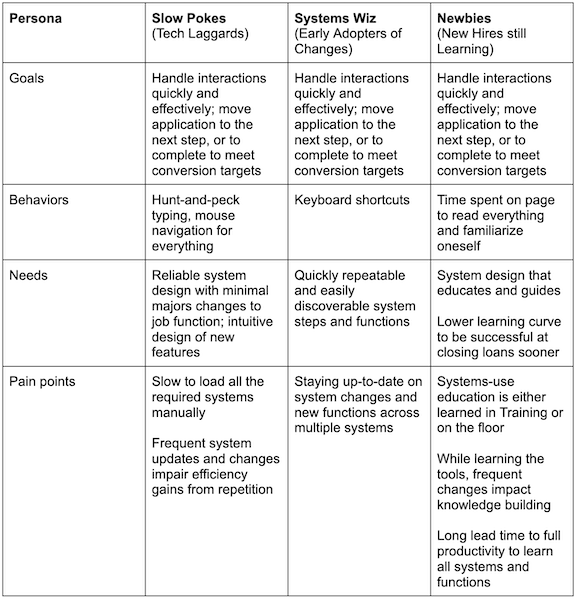
Personas for Internal Tool
Having a clear and communicated view of who the customer truly is enables us to design better solutions for clear customer goals and challenges. The above example is specific to an internal tool and is not immediately replicable for a consumer-facing product. Consumers are faced with a life context that influences their product decisions. As well, they experience barriers to engaging with your product (lack of awareness, relative high costs, resistance to change, risk aversion, etc.). These additional elements should be part of your persona definition.
At Lowe & Co Growth Advisors, we can help you define personas that are data-driven, actionable, behavior-based and validated. We instill the fact that personas change with time and as a product's lifecycle stage changes. If you are interested in learning more, connect with us!