
Operations Transformation in the Age of AI: Automating Human Processes for Scale
TL;DR
AI is reshaping operations by eliminating manual workflows, reducing errors, and enabling teams to scale without increasing headcount. This post explains how to identify processes ready for automation, map current workflows, quantify cost and error rates, and build an AI roadmap. It also introduces the concept of “Curation” — the essential early work needed before AI development — and shows how AI unlocks operational leverage across customer support, verification, decision-making, and back-office tasks.
In today’s economy, companies are under pressure to do more with less and faster. Customer expectations are rising, margins are getting tighter, and teams are expected to deliver high-quality experiences without scaling headcount linearly. The organizations that succeed aren’t just digitizing their operations; they’re transforming them. At the center of that transformation is AI-powered automation.
AI is reshaping how work gets done by eliminating repetitive tasks, reducing operational cost, improving accuracy, and freeing teams to focus on higher-value strategic work. But meaningful transformation doesn’t start with tools — it starts with rethinking how the people within Operations and systems work together. More often than not, human processes are implemented where technology was either too cumbersome, too costly or too slow to implement. Over time, growth can highlight that the human processes create a bottleneck giving rise to the need for automation as a growth lever.
What Is Operations Transformation?
Operational transformation is the end-to-end redesign of business processes, systems, and organizational workflows to improve efficiency. Along with efficiency gains, the aim is to increase velocity, increase experiential and product quality, and achieve more favorable economics. This is not only to make the bottom line grow, but also for customers. We are not simply “fixing broken processes”; we are reimagining how the entire operation should work. The goal is to create a lean, automated, insight-driven operation that supports growth instead of slowing it down.
Why AI Is the New Engine of Operational Excellence
AI changes the game by enabling systems to understand natural language, generate or summarize content, and assist agents in real-time. Instead of humans feeding systems inputs, systems can now interpret and act. The result is outsized operational leverage. Think about a customer who now does not need to reach out to an agent for information or to perform something. Or an agent that doesn't need to do something routine and repetitive, but can now focus on more strategically-aligned work like proactive outreach to stalled customers.
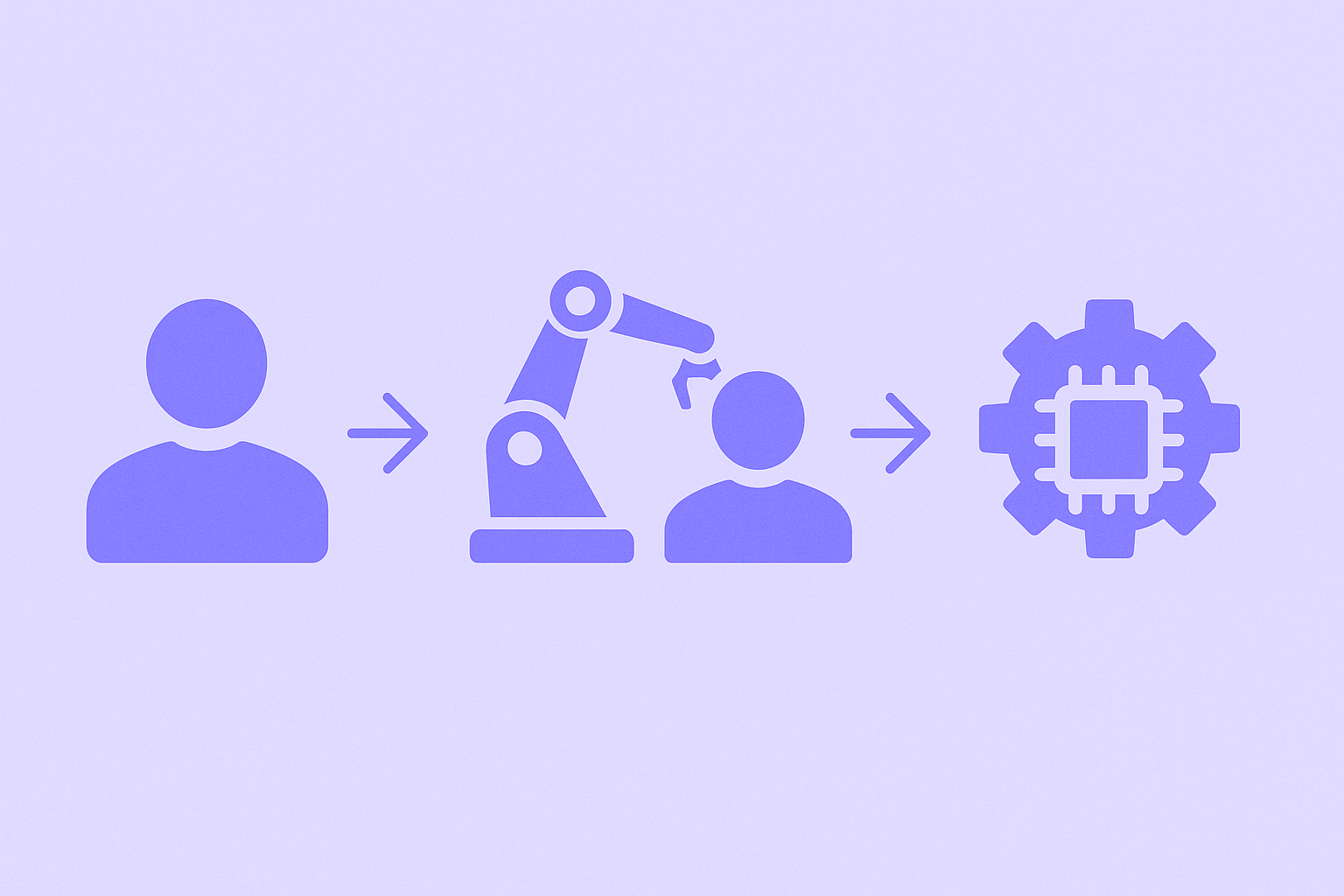
AI systems can respond directly to customers in the form of a chatbot. They can recommend sample responses for agents to deliver to a customer or even recommend knowledge base items like a specific procedure. They can even process backoffice tasks where no customer outreach initiates a process (ID verification, document verification, document data extraction, file fraud detection). The main theme here is that within Operations, we can leverage AI to prevent customers from reaching out to humans (through deflection and automation) and leverage AI again to help when outreach is unavoidable. Many repetitive processes that humans do are slow and error-prone and companies can benefit from increased accuracy and shorter time to execute with AI.
Building an AI Backlog
Before we can arrive at a prioritized roadmap, we need a backlog of ideas. Generating those ideas requires some homework to become familiar with the operation and painpoints:
Map Current Processes
Identify Highly Repetitive Processes
Quantify the Volume, Cost, Error Rates
Assess the Risk and Compliance Requirements
We start by documenting every step of each high-volume process. This includes process inputs, tools, decisions, handoffs, and edge cases. Once we have mapped everything for a given process, we need to look at manual data entry, reconciliation (“stare & compare"), repetitive decision-making, copy/paste workflows, and template-based communication as these are ideal for AI automation. In a similar vein, high frequency, high variability and high error-rate processes are also perfect candidates. Lastly, we must consider the risk to the business if we don’t decrease error rates on a specific process or have a process that yields results that are out of compliance. These can all impact how we might prioritize one initiative over another.
AI Product Development
Now that we have discussed building a backlog and roadmap of AI initiatives, I wanted to take a moment to talk about AI Product Development and how it's a little nuanced from traditional software product development. In traditional software product development, you have:
Idea Generation
Requirements Analysis
Product Design
Integration and Testing
Deployment
On-going Maintenance / Iterative Experimentation
With AI Product Development, we need to expand a little here. AI specifically will require a new category of work I have called “Curation”. Curation is the early-on and on-going collaboration between, at the minimum, Product, Engineering, and Operations. During Curation, important actions are completed around model selection, model training and prompt engineering, and model development. In addition, there are considerable business-readiness activities that must be completed first. As a personal example, building a chatbot to handle direct interactions with customers required months of Curation in the form of building a knowledge repository - translating internally drafted procedures for an agent into customer-facing guidance for self-service. The main takeaway here is that considerable legwork is needed before jumping into the development of AI and Lowe & Co Growth Advisors is here to help.